“Hypoallergenic” is printed on millions of jewelry cards and defined almost nowhere. For a trade buyer the claim is a specification question, not a marketing one: which metal, which test, which threshold makes the word true on your card, in your market, under your brand.
What actually causes reactions
Nickel release is the dominant cause of contact dermatitis from jewelry. Cobalt plays a smaller but real role. The metal itself matters less than what leaches: a plated alloy can be safe until the plate wears, which is why the honest claim is about the whole construction, not the base metal.
Build the claim on four lines
Base metal
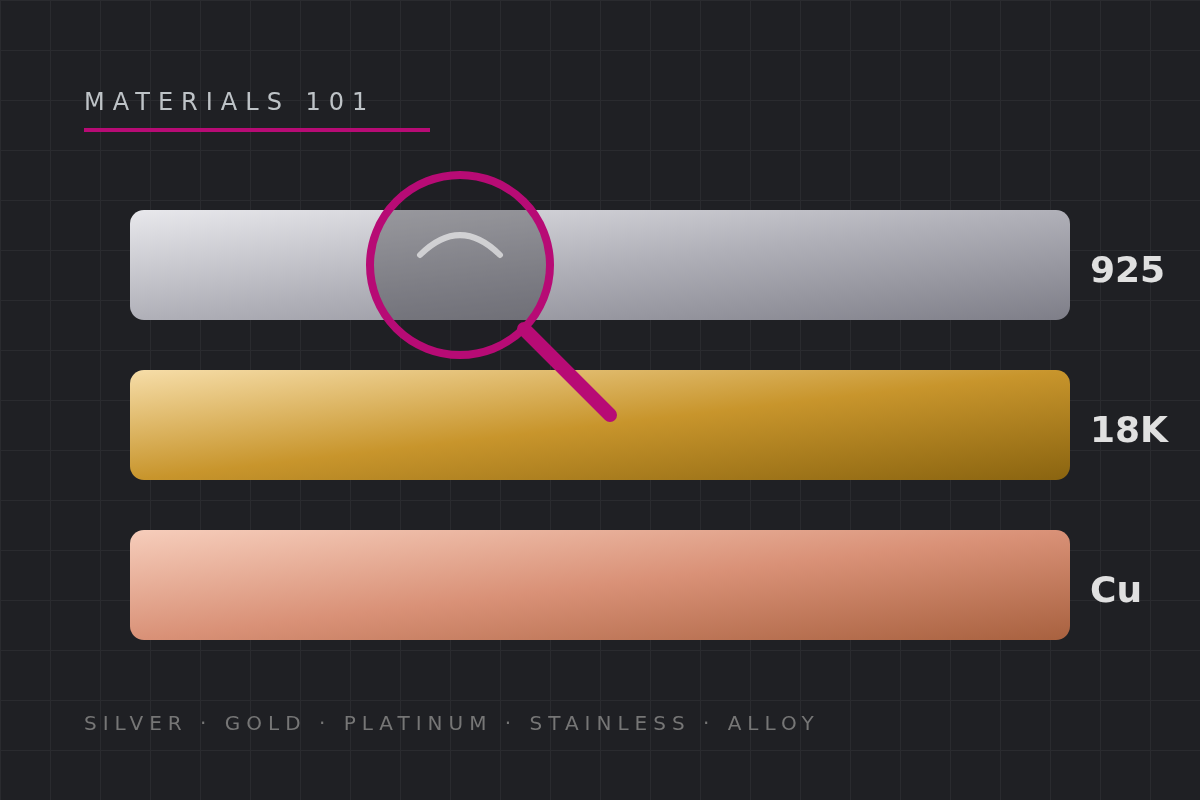
Surgical stainless (316L), titanium, niobium and sterling silver are the standard low-nickel choices. Note that some 316L still releases trace nickel; the test, not the catalogue, decides.
Plating barrier
A palladium or rhodium barrier layer under the gold dramatically reduces nickel release and is the standard construction for sensitive-skin lines on plated goods.
Test evidence
EN 1811 nickel release results below 0.5 (0.2 for pierced), run on the finished plated piece. For a stronger consumer claim, the EU “nickel free” practice and US expectations converge on tested release, not on the words themselves.
Scope of the claim
Say what was tested: posts, clasps, chain in contact. A claim on the earring post does not cover the base-metal pendant it hangs from.
| Construction | Test basis | Card wording that holds |
|---|---|---|
| Titanium posts, no plating | EN 1811 pass | Titanium posts, nickel-release tested |
| 316L + palladium barrier + gold | EN 1811 pass | Nickel-release tested under EN 1811 |
| Sterling silver 925 | EN 1811 pass | 925 sterling, low-nickel construction |
| “Nickel free” alloy, untested | None | Do not print |
Get it in the specification, not on the card
Put the metal, barrier layer, test method and pass thresholds into the purchase order spec sheet, and require the test report with the shipment. The card can then repeat the spec in consumer language, and your claim survives a market surveillance check or a retail customer’s own audit.
Frequently asked questions
Yes for stones sold as diamonds. IGI and GIA issue reports for lab-grown stones, and the report number is usually laser inscribed on the girdle.
Both are accepted in trade; IGI is the volume standard for lab-grown while GIA carries broader consumer recognition. What matters more is the process: match the laser inscription to the report at receipt, every stone, every delivery. The certificate without inscription matching is paper, not protection.
For parts in prolonged skin contact, yes in practice: the REACH nickel entry limits release, and EN 1811 is the reference method for plated items. Collect the report on the plated finish from the plating supplier, a declaration of conformity per style from the factory, and re-test when the plating supplier changes. Reports on bare metal are not evidence.